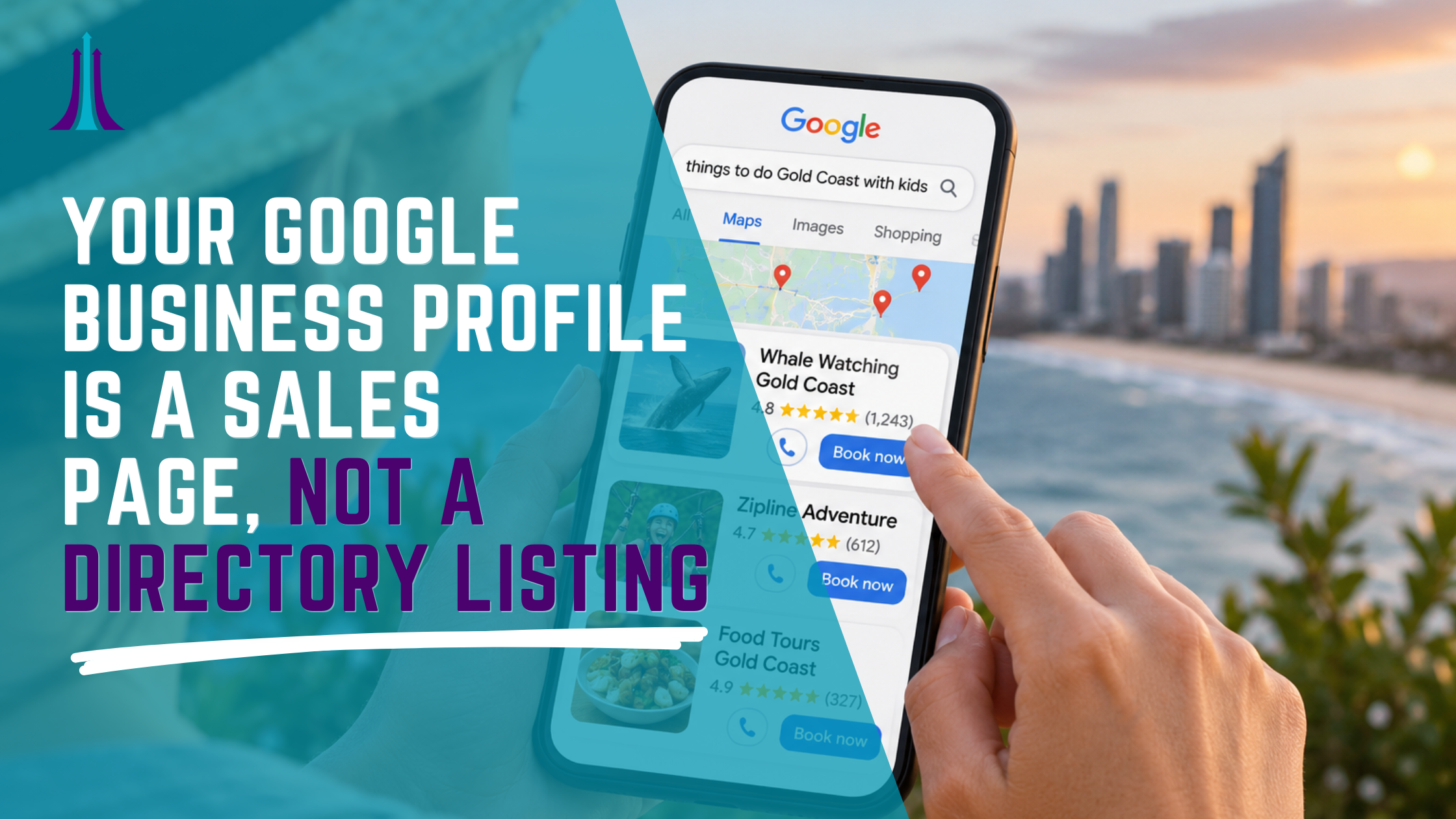
Your Google Business Profile is one of the most important sales pages in your tourism business, but a lot of operators still treat it like an online version of the Yellow Pages.
They set it up, add the address, upload a few photos, maybe update the opening hours once a year and then leave it alone.
The problem is that your customer is often making a decision right there.
They have searched for something like “things to do near me”, “whale watching Gold Coast” or “food tours Melbourne”. Your business comes up beside several others and, before they ever reach your website, they are already comparing you.
They are looking at your photos, your reviews, your rating, your location, your opening hours and whether the business looks current.
That is not a directory listing.
That is a sales decision.
Think about how people actually use Google when they travel
Tourism operators spend a lot of time thinking about Google search results, but there is another behaviour happening at exactly the same time.
People open Google Maps.
They search around where they are staying.
They look at what is nearby, what has good reviews and what looks interesting.
Imagine a family staying on the Gold Coast. It is 7pm and they are deciding what to do tomorrow. They are not sitting down to conduct a detailed research project.
They search “things to do Gold Coast with kids”.
Your business appears.
So do five others.
At that point they may never even reach your homepage.
They look at the photos first. Then the rating. Then the recent reviews. They check whether you are open tomorrow. They might look at the questions people have asked. If everything feels right, they click through and book.
If the profile looks abandoned, they move on.
That is why I would treat your Google Business Profile with the same care you give one of your main product pages.
The photos need to show the experience people are actually buying
This is the first thing I would look at.
Tourism businesses often have hundreds of great images sitting in folders, on phones and across social media, while their Google profile is showing six old photos from three years ago.
Or worse, the first image somebody sees does not really explain what the experience is.
If you run a zipline, show people on the zipline.
If you run a food tour, show the food, the guide and the places people actually visit.
If you run a cruise, show the vessel, the view and the experience from the guest's perspective.
Do not make the traveller work out what you sell.
I would also make sure the photos still represent the business today.
If the vehicle has changed, the meeting point has moved or the product now looks different, update it.
There is nothing worse than booking something based on one expectation and arriving to find something else.
That gap starts before the booking, not after it.
Reviews do more than make you look good
Most operators understand that reviews matter.
What gets missed is how much information people pull from them.
A future guest is not only looking at whether you have 4.8 stars.
They are reading what people actually say.
They want to know whether the guide was good, whether the kids enjoyed it, whether it felt rushed, whether the meeting point was easy to find and whether somebody helped when something went wrong.
That means the language inside your reviews becomes part of the way people understand your experience.
I would read your recent reviews and look for patterns.
What do guests keep mentioning?
That is often where your strongest selling points are hiding.
If ten people mention how patient the guides were with nervous children, that matters.
If people constantly talk about the small group size, that matters.
If guests keep mentioning the view at sunset, that matters too.
Those are the things future customers are looking for because they are coming from other guests, not from you.
Your response matters as much as the review
I would also respond to reviews properly.
Not with the same copy-and-paste line every time.
You do not need to write an essay, but you should sound like a person.
A simple response that refers to something the guest actually mentioned tells the next person reading that there is a real business behind the profile.
Negative reviews matter even more.
I know operators hate them. Nobody likes opening Google and finding that somebody has given them one star after a day they thought went perfectly well.
But the response is not really for the person who left the review.
It is for the next 100 people who read it.
They are watching how you handle a problem.
A calm, reasonable response can give somebody more confidence than a page full of perfect reviews.
Keep the practical information current
This sounds basic, but it is one of the easiest places to lose trust.
Opening hours are wrong.
The phone number has changed.
The website link goes somewhere old.
The map pin is slightly off.
A public holiday comes around and the profile still says you are open when you are not.
If I was running a tourism business today, I would put a simple check of the Google Business Profile into the operating rhythm.
It does not need to become another big marketing job.
Take 20 minutes once a month and check the basics.
Are the hours right?
Does the booking link work?
Are the photos current?
Have you answered the new reviews?
Has anything changed in the business that a guest needs to know?
That small amount of maintenance is much easier than trying to repair trust after someone drives to the wrong location.
Answer the questions before they become objections
Google also gives people a place to ask practical questions, and these are useful because they show you what customers are unsure about.
If people are asking whether children can participate, whether parking is available or what happens when it rains, I would pay attention.
Those questions are telling you where the hesitation is.
The same question may also need answering on your website, in your pre-arrival email or in the booking process.
This is something I think operators should get better at.
Do not treat customer questions as interruptions.
Treat them as information.
They are telling you what is missing from the sales process.
Make sure the next step is obvious
Once someone has decided they like what they see, do not make the next step difficult.
If you can send them directly to the right booking page, do that.
Do not send somebody who has searched for a particular experience back to a generic homepage and expect them to find it again.
If they searched for a whale-watching cruise, take them to the whale-watching cruise.
If they searched for a particular location, take them to that location.
The shorter the distance between “this looks good” and “I have booked it”, the better.
That is the same principle I talked about with your website booking path.
The customer should not have to keep making the same decision twice.
Google Business Profile is part of your booking system
I would stop thinking of Google Business Profile as something the marketing team looks after.
It sits right in the middle of how people find, assess and choose tourism experiences.
That makes it part of your sales system.
You do not need to be posting to it every day or turning it into another social media channel.
You do need the information to be accurate, the photos to represent the experience, the reviews to be managed and the path to booking to be clear.
Start there.
Open your own Google Business Profile as if you were a traveller who had never heard of you before.
Look at the first photos.
Read the latest reviews.
Check the hours.
Click the link.
Then ask yourself whether what you are seeing would give you enough confidence to book.
If the answer is no, that is where I would start.
If you want to look at where people are finding your business and what is getting in the way of the booking, book a Growth Gap Call with me.