Peak Season Chaos? Your Tourism Business Has Outgrown Its Systems

And why that's a growth signal — if you catch it early enough
I have worked with a lot of tourism operators over the years.
Built and exited three tourism businesses of my own. And the pattern I see most often has nothing to do with product quality, location, or even competition.
The operators who struggle most are the ones whose businesses grew faster than their systems did.
Here is the thing about peak season in tourism: it doesn't create problems. It exposes them. The cracks were already there. December just turns the light on.
If you are heading into your busy period feeling anxious instead of confident, it is worth asking yourself a hard question: are you actually ready to handle the volume or are you just hoping the wheels stay on?
Growth Without Redesign Is Just Pressure

Most tourism businesses grow organically.
You add a departure.
You hire a couple of casuals.
You take on more OTA bookings.
You bring in a new experience or extend your season.
None of that is wrong. But growth adds complexity, and complexity without structure creates chaos.
The day you opened, you probably ran everything. You knew every booking, every staff member's name, every quirk of the product. That worked when you were doing ten departures a month. It falls apart at sixty.
The business has grown. The systems haven't. And peak season is where you feel it most.
The Imperative of Change in Organizations: Understanding Why Change is Necessary
Six Signs You Have Outgrown Your Systems
1. Your operation runs on people remembering things
If the answer to "how does that work?" is "ask Dave," you do not have a system. You have a person. And the day Dave calls in sick during school holidays, you will discover exactly how much of the business lives in his head.
Think about what this looks like in practice.
Pre-departure communications that depend on whoever opens their emails first. Safety briefings that vary depending on which guide is on. Inclusions that get mentioned on some departures and forgotten on others. Upgrade conversations that happen when the senior guide remembers to have them, and skip when a casual is running the day.
I saw this play out at a reef day-cruise operation. Their guides were experienced, passionate, and knew the product inside out. But every day ran slightly differently. Guests who had read the website and guests who had spoken to a staff member had different expectations about what was included. The team spent the first hour of every departure managing the gap between what people expected and what was actually happening. That is not a people problem. That is a documentation problem.
The non-negotiables in your business — guest communications, safety briefings, handovers, inclusions, how you handle late arrivals — need to be written down, trained into the team, and checked. Not because your guides are not capable, but because consistency cannot rely on memory.
2. Small changes create large disruptions
A weather change, one extra booking, a staff member who calls in sick, a coach that runs twenty minutes late. In a well-designed operation, these are inconveniences. In an operation held together by habit and goodwill, any one of them can derail the day.
If you do not have a clear "Plan B" for your most common disruptions, you are making it up on the fly every time they happen. And in peak season, they happen constantly.
One wildlife tour operator I worked with had no documented process for weather-affected days.
The product ran outdoors, so weather changes were not rare — they were a regular feature of the season. But every time conditions shifted, the same series of panicked conversations happened. Who calls guests?
What do we offer?
Is it a full refund, a credit, a reschedule?
Does the owner need to approve?
Who contacts the driver?
By the time they had worked through all of that, the guest experience was already compromised — even before the tour had started.
The fix was straightforward: map the twenty most likely disruptions in your business and decide in advance what happens in each one. Who acts, what they do, what authority they have, and what the guest communication looks like. It takes half a day to build. It saves you from reinventing the wheel every time conditions change.
3. You have become the system

This one is the most important, and the most uncomfortable.
If refunds need your sign-off, if complaints come straight to your phone, if the new guide cannot confirm a booking without checking with you, if every exception requires your judgment — you are not running a business. You are the business.
I have been there.
Early in my business owner days, I told myself that being involved in everything was about maintaining standards. The real reason was that I had never built the systems or trained the team to operate without me. My involvement felt like quality control. It was actually a bottleneck.
Think about what this costs. A guest complaint that your duty manager could handle in three minutes instead sits in your inbox for four hours because they do not feel authorised to act. A private booking enquiry goes unanswered over a long weekend because only you can quote it. A review that needs a response waits until you surface from whatever crisis you are currently managing.
And meanwhile, you are exhausted. You are across everything and ahead of nothing.
The solution is not to let go of standards.
It is to build the structure that holds standards without you in the room. That means defining authority levels — who can approve what, up to what dollar amount, under what circumstances. It means giving your team genuine decision-making power for the situations they face every day. And it means trusting the training you have given them.
Your business cannot scale if it needs you to function.
4. You are flat out, but nothing is actually improving
Busy and productive are not the same thing.
I see operators who work ten, twelve, fourteen hours a day during peak season and finish the period no further forward than when they started.
The revenue is there.
The exhaustion is there.
The progress is not.
This usually comes down to where the work is actually going. In operations that have grown without redesign, a huge amount of daily effort goes into managing the consequences of inefficient workflows. Manual confirmations that a decent booking system would handle automatically. Changes communicated via text, then re-entered into a spreadsheet, then checked against a run sheet on someone's phone. Information that lives in three different places and needs to be reconciled by hand every morning.
One small Queensland hotel group I worked with calculated that their front desk team was spending roughly ninety minutes each shift just reconciling information between systems — cross-checking their PMS against a manual log the housekeeping supervisor kept in a folder, against a whiteboard in the back office. Three sources of truth, none of which matched perfectly, all of which required human time to bridge.
That ninety minutes per shift was not delivering anything to guests. It was just managing the gap between a system that had not been properly designed and an operation that had grown past it.
Map what actually happens in your business from the moment a booking lands to the moment a guest leaves and writes a review. Where does information get entered more than once? Where do people wait for other people? Where does the work slow down? That map will show you where your hours are going.
5. Your reviews are inconsistent, and you know why

In tourism, your reviews are your reputation and your reputation is built or broken by the consistency of delivery.
Consistent does not mean scripted.
Guests do not want a robotic experience. They want a reliably excellent one. The difference between a business that averages 4.2 stars and one that consistently earns 4.8 is usually not the product. It is the reliability of the experience around the product.
If your reviews cluster around certain guides, certain days, or certain conditions, that tells you something important: your quality is person-dependent. One of your guides is extraordinary. Another is competent but inconsistent. A third is still finding their feet.
Without systems to support delivery, guests experience three different businesses depending on who they get.
I have seen wildlife tour operations where one guide consistently received five-star reviews and another, running the same product on the same route, averaged three and a half. The product was identical. The storytelling, the pacing, the guest interaction, the way they handled questions — none of it was documented, trained, or standardised. The business had one exceptional guide and hoped the others would figure it out eventually.
The guest journey; what happens before they arrive, during the experience, and how you follow up afterward — needs to be designed and trained, not left to individual interpretation. That does not remove the personality from your product. It protects the standard while still leaving room for your team to bring themselves to it.
6. Your fixes do not stick
You have tried this before. You ran a team meeting and talked about communication. You built a checklist. You introduced a new tool. You put a run sheet on the wall.
And two weeks later, everything went back to the way it was.
Fixes fail for a specific reason: they address symptoms instead of causes. If guests are getting inconsistent pre-arrival communications, telling your team to "communicate better" is not a fix. A templated communication sequence tied to booking milestones is a fix. If a new guide keeps making errors on their first week, a pep talk is not a fix.
A structured onboarding checklist with checkpoints and sign-offs is a fix.
Tools and checklists also fail when you introduce them without redesigning the underlying workflow. You cannot solve a broken process by adding a layer on top of it. The process comes first. The tool serves the process.
And fixes fail without accountability. Someone needs to own each process. Someone needs to check that it is running correctly. Someone needs to have the authority to call it when it is not.
If your improvements never quite stick, that is not a team problem. It is a design problem.
Why This Happens
Tourism businesses grow by adding volume. More departures, more channels, more staff, more complexity. Very few stop and redesign how the business actually works to accommodate that growth.
The systems that handled fifteen bookings a month cannot handle sixty. The communication approach that worked when you personally knew every guest does not scale to OTA volume. The rostering method that worked with four guides falls apart with fourteen.
None of this is failure. It is the predictable result of growth that outpaces structure.
The question is whether you catch it and address it, or keep running on adrenalin until something breaks.
Where to Start
Before you hire more staff, invest in a new booking system, or throw money at marketing, get clear on how your business actually works right now.
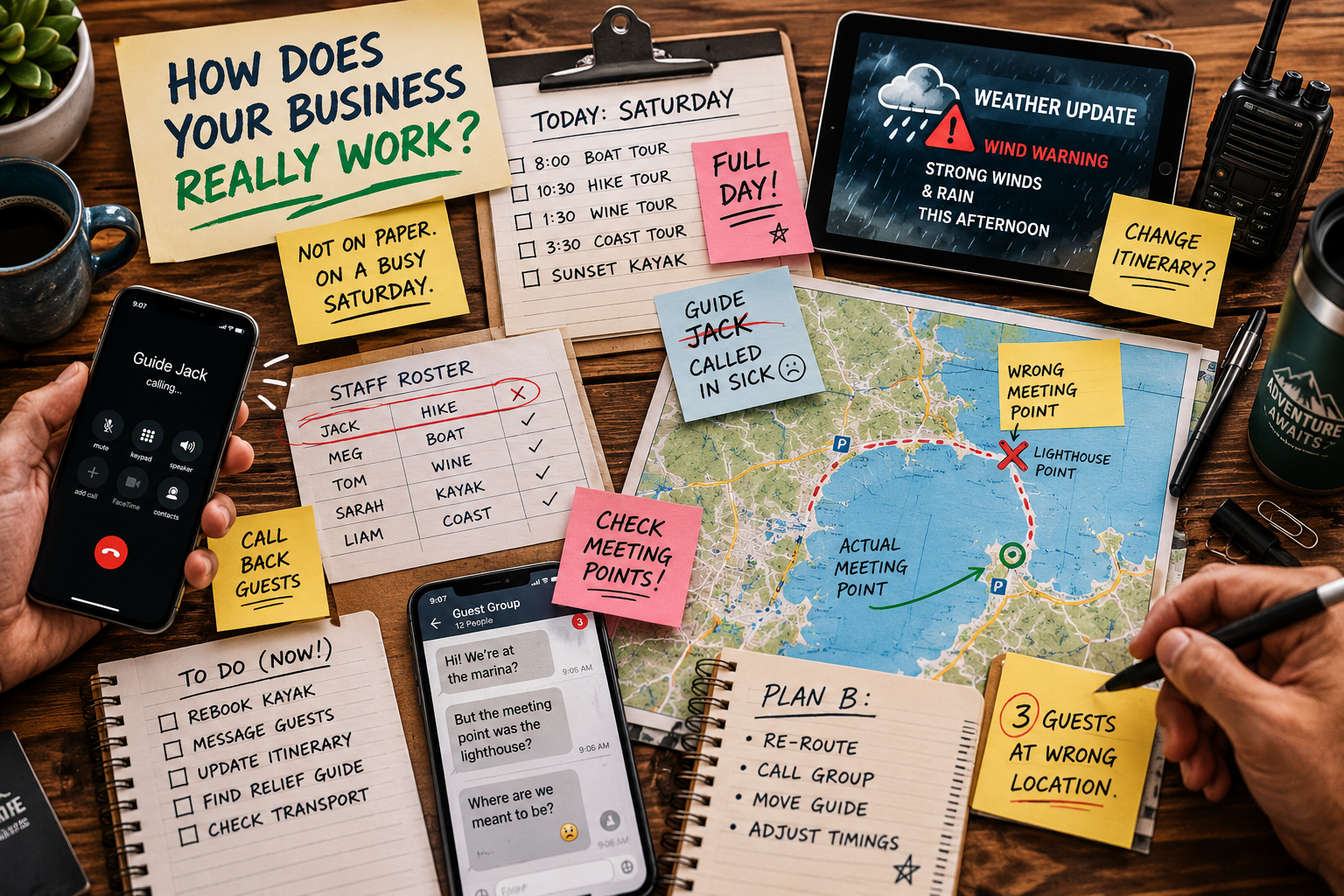
Not how it is supposed to work. How it actually works, on a busy Saturday, when a guide calls in sick and the weather turns and three guests show up at the wrong meeting point.
That honest look at your operations, at how work flows, where the bottlenecks are, what is causing inconsistency, and what is costing you margin is where real improvement begins.
If your peak season feels profitable but painful, or you are busy but still can not get ahead, it is time to find out why.
Sarah Colgate is a Business Improvement Professional and the founder of Exceptional Experiences. She has built and exited three tourism businesses and works with operators across Australia to improve profitability, simplify operations, and build businesses that do not depend on the owner being in the room for everything to work.
To speak with Sarah directly, visit exceptionalexperiences.com.au
Structuring your Business for Success
Top 5 Issues Tourism Business Owners Need Help With – and How to Solve Them